also defines: heterovalent hyperconjugation, isovalent hyperconjugation, sacrificial hyperconjugation
https://doi.org/10.1351/goldbook.H02924
In the formalism that separates bonds into $\ce{\upsigma\!}$ and $\ce{\uppi\! types}$, hyperconjugation is the interaction of $\ce{\upsigma\!\mbox{-}bonds}$ (e.g. $\ce{C–H}$, $\ce{C–C}$, etc.) with a $\ce{\uppi\!}$ network. This interaction is customarily illustrated by contributing structure, e.g. for toluene (below), sometimes said to be an example of 'heterovalent' or 'sacrificial hyperconjugation', so named because the contributing structure contains one two-electron bond less than the normal Lewis formula for toluene: 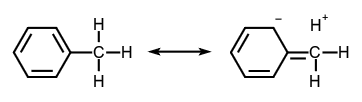 At present, there is no evidence for sacrificial hyperconjugation in neutral hydrocarbons. The concept of hyperconjugation is also applied to carbenium ions and radicals, where the interaction is now between $\ce{\upsigma\!\mbox{-}bonds}$ and an unfilled or partially filled $\ce{\uppi\!\mbox{-}}$ or p-orbital. A contributing structure illustrating this for the tert-butyl cation is:
 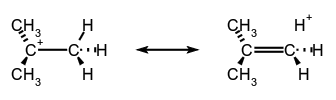 This latter example is sometimes called an example of 'isovalent hyper-conjugation' (the contributing structure containing the same number of two-electron bonds as the normal Lewis formula). Both structures shown on the right hand side are also examples of 'double bond-no-bond resonance'. The interaction between filled $\ce{\uppi\!\mbox{-}}$ or p-orbitals and adjacent antibonding $\ce{\upsigma\!^{\ast}\mbox{-}orbitals}$ is referred to as 'negative hyperconjugation', as for example in the fluoroethyl anion: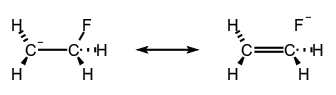
See also: n-σ*, delocalization, sigma, pi